Listen Up
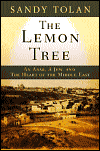
In 1998, journalist Sandy Tolan broadcast this award-winning radio documentary, The Lemon Tree (38:30), dealing with an Israeli (Dalia) and a Palestinian (Bashir) who come to share the same house (one with a lemon tree in the backyard).
Bashir Al-Khairi (buh-SHEER al-HAY-ree), an Arab, was six when his family was driven out of his stone home in Ramle, in old Palestine, during the war with Israel in July 1948. Dalia Eshkenazi, a Jew, was ten months old when her family arrived from Bulgaria in November 1948, and moved into an old stone home in Ramle. Nineteen years later, after the Six Day War, Bashir went to visit his old home. He rang the bell. Dalia answered.In May 2006, Tolan published a book version of his story, and gave this extended radio interview (25:03) updating his story.
Write Now
- There’s an old saying about never discussing politics or religion at the dinner table – a rule that suggests the importance of separating ideology and beliefs from ordinary human interaction. What do you think of such advice?
- Some of the life’s biggest problems come from two people wanting one thing that cannot be readily shared – think of the famous biblical story of Solomon trying to divide a baby between two mothers. Is there a political lesson here as well?
- One of the themes of “The Lemon Tree” is the value or the limits of dialogue – just how far talk will carry one in resolving a dispute. What is your sense of this matter: when to continue versus when to end a dialogue?
- More from Wikipedia on the town of Ramle (or Ramla)

